













Temperature
A temperature sensor turns heat into a signal you can read or control with: the resistance of an RTD such as a Pt100, or the small voltage of a thermocouple. PIC Engineering supplies RTDs, thermocouples, thermowells and inserts from Aplisens, Thermo Electric and Leitenberger, plus transmitters, switches, controllers and data loggers. Sensors of any make can be checked by our calibration services in Shah Alam. New to the subject? Read what a thermocouple is, and how it differs from an RTD.

2 wire head mounted Temperature Transmitter HART
2 wire head mounted transmitter 4-20mA
The PR Electronics 533x Series features head-mounted, 2-wire programmable temperature transmitters for DIN Form B heads. They convert RTD, TC, Ohm, and mV inputs into a stable 4–20 mA loop. The series includes the universal 5331, dedicated RTD 5333, and HART-enabled 5335/5337. Running on 7.2–35 VDC with up to 1.5 kVAC isolation, they ensure high accuracy (<0.05%). Operating on a loop-powered principle, they use two shared power/signal wires for noise-immune transmission. They are perfect for precise industrial processing, valve tracking, and hazardous zone deployment (Ex D variants).
The series is categorized into “A” variants (for safe areas or ATEX Zone 2) and “D” variants (ATEX/IECEx certified for hazardous environments).
2 wire head mounted transmitter dual input

AT-2 Head-mounted smart temperature transmitter
- Sensor Compatibility: Features user-programmable options for Pt100 and Ni100 thermal sensors.
- Line Compensation: Equipped with 3-wire thermoresistance line compensation to ensure signal accuracy over long cable runs.
- Output Profile: Transmits a standard 4–20 mA current loop signal with an operating power supply of 7.5 to 30V DC.
- Compact Layout: Engineered specifically for easy installation directly inside standard B-type sensor connection heads.

ATL Rail-mounted temperature transmitter
- Sensor Tracking: Fully compatible with resistive Pt100 and Ni100 RTD sensors.
- Line Correction: Outfitted with a 3-wire thermoresistance line compensation system to maintain measurement accuracy over extended cabling.
- Output Profile: Delivers a standard 2-wire 4–20 mA current loop signal operating on a 6 to 29 V DC power supply.
- Smart Setup: Features a programmable measuring range and sensor selection configurable via a PC setup kit.

ATX Head-mounted ex proof smart temperature transmitter
- ATX-2 (Multi-Sensor): Features broad sensor compatibility, accepting Pt100, Pt500, Pt1000, and Ni100 RTDs with built-in 3-wire line compensation.
- ATX-3 (Dedicated Pt100): Specialised for Pt100 (2- or 3-wire) configurations, adding a local LED indicator for immediate fault and sensor-break signaling.
- Intrinsically Safe Build: Both models are fully ATEX certified (e.g., Ex ia IIC T6) for Zone 0 deployment.

CT Temperature Cable Sensor Series
- CT GE1: Features a straight metal sheath with a threaded process ferrule for secure immersion or pipeline mounting.
- CT E1: A simple, versatile cable probe without fixed process threads, ideal for generic insertion into thermowells or surface mounting.
- CT Z1: An outdoor air and ambient temperature sensor equipped with a specialised terminal housing for environmental climate tracking.

CT Temperature Industrial Sensor Series
The Aplisens CT series encompasses industrial temperature sensors offered as Pt100/Pt1000 resistance thermometers (RTD) or thermocouples (TC). These sensors are engineered with integrated protection tubes or additional thermowells for robust process integration. High-Temperature (CT C, CT U): Reaches up to 1700°C using mullite ceramic 610 or heat-resistant steel, designed for furnaces and chimneys.
- Standard Industrial (CT GB1, CT GN1): Covers ranges from -70°C to +550°C (Pt100 from -196°C on request), wetted parts in 316 stainless steel.
- Flexible Insert (CT X): Built without a protection tube for tight, non-aggressive spaces like machine bearings.
- Safety: Fully certified with ATEX Exia / Exd and DNV marine classification.

Datalogger PMS 90R
The industrial data logger PMS-90R is designed to record and display current values as well as to present technological parameter in the form of graphs. The device is equipped with1, 4 or 8U/I inputs (0/4-20mA, 0/1-5V, 0/2-10V) or RTD/TC inputs (Pt100, Pt500, Pt1000, TC type K, S, J, T, N,R, B, E), one impulse (digital) input for controlling the recording process and one USB Host port for flash data storage.
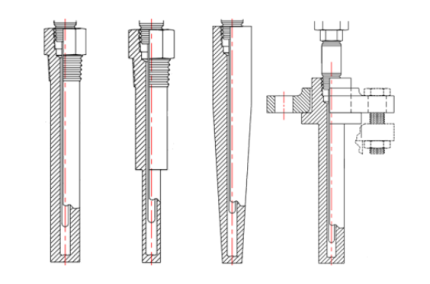
Drilled Bar Well Assemblies
Drilled Bar Well Assemblies from Thermo Electric are heavy-duty, high-integrity thermowell monitoring systems engineered to shield delicate temperature sensors (RTDs or thermocouples) from extreme fluid velocities, mechanical stress, and aggressive chemical erosion. Machined entirely out of a single, solid piece of metal bar stock, these deep-drilled enclosures establish a pressure-tight barrier inside process pipelines and tanks. This solid-metal design eliminates the structural weld seams found in lower-cost protection tubes, preventing process leakage while allowing maintenance crews to safely extract or swap the internal sensor elements without shutting down the main production line.

GI-22 Head-mounted ex proof temperature transmitter
- Universal Inputs: User-programmable configuration supporting diverse sensor options including Pt, Ni, and multiple thermocouple types (J, K, N, S, R, B).
- Signal Correction: Built-in 3- and 4-wire thermoresistance line compensation alongside thermocouple cold-junction compensation.
- GIX-22 (Intrinsically Safe): Dedicated variant fully certified with ATEX Intrinsic Safety approvals (II 1G Ex ia IIC T6) for Zone 0 hazard zones.

HUMIDITY & TEMPERATURE CONTROLLER
The mL-HTC Temperature + Humidity controller is designed for the control of humidity and temperature in industrial processes. PID or On / Off control is available to control the process. 4 Relays are offered for control and alarm outputs.
They are mainly used in glass, plastic, petro-chemistry, textile, automotive and machine production industries.
How a temperature sensor works
Most electrical temperature sensors in process plants use one of two elements. An RTD (resistance temperature detector) has a platinum element whose resistance rises with temperature: a Pt100 has 100 Ω at 0 °C and a Pt1000 has 1,000 Ω. Aplisens rates its RTDs for −196 to +600 °C. A thermocouple is two different metals joined at the measuring point. The temperature difference between that hot junction and the cold junction at the wire ends produces a small voltage. Thermocouples reach higher temperatures, up to 1,700 °C with the platinum types S and B.
In an industrial sensor such as the Aplisens CT, the element sits in a spring-loaded insert inside a protection tube or thermowell, and the insert can be replaced while production keeps running. Surface sensors, such as pipe clamp and tube skin sensors, measure from outside the pipe instead. The signal goes to an indicator, a controller or a data logger, or to a temperature transmitter that converts it to 4 to 20 mA for the control system.
The temperature sensor range PIC supplies
| Category | What it does | Range and notes | Products |
|---|---|---|---|
| Industrial sensors | Immersion sensors for pipes, tanks and vessels | Aplisens CT: Pt100 or Pt1000 RTDs or thermocouples, high temperature versions up to 1,700 °C, ATEX and DNV marine versions. Leitenberger LTS 120: −50 to +400 °C, optional head transmitter or display. LTS 150, 450 and 490: Pt100 class A for food, IP69K versions | Aplisens CT series; Leitenberger LTS 120, LTS 150, LTS 450, LTS 490 |
| Thermocouples | Measure surfaces, furnace tubes and temperature profiles | Surface mount thermocouples, tube skin sensors for furnace tubes, and multipoint assemblies that measure a profile through one process entry | Thermo Electric surface mount thermocouples, tube skin sensors, multicouples |
| Surface sensors | Measure a pipe or surface without entering the process | Pipe clamp sensors with thermocouple or Pt100 elements: no thermowell and no entry into the process | Thermo Electric pipe clamp sensors, surface mount thermocouples |
| Cable sensors | RTD probes on a flexible cable, for machinery and tight spaces | Pt100 or 2 x Pt100, 2, 3 or 4 wires, with a process thread (CT GE1) or a plain sheath (CT E1), ATEX Ex ia option | Aplisens CT cable sensors |
| Thermowells and inserts | Protect the sensor and let it be changed without opening the process | Aplisens OG welded thermowells in 316L or 316Ti; Thermo Electric wells drilled from solid bar. Aplisens W2 insert: Pt100 −70 to +500 °C, type K up to 1,000 °C, types S and B | Aplisens OG thermowell, W2 measuring insert; Thermo Electric drilled bar well assemblies |
| Wafer sensors | Temperature across a silicon wafer in semiconductor process tools | Instrumented wafers with thermocouples or RTDs, measuring at the wafer surface | Thermo Electric instrumented wafer sensors, RTD wafer sensor |
| Transmitters | Convert the sensor signal to 4 to 20 mA | Head, rail or field mounting; RTD and thermocouple inputs; HART; one or two channels; Ex and SIL versions | Aplisens LI-24ALW, LI-24G, LI-24G/AL, LI-24L, GI-22, ATX, AT-2, ATL, PT-25; PR electronics 533x series, 5337, 5437 |
| Temperature switch | Switch at a set temperature and report to the control level | Electronic switch with IO-Link and a 4-digit LED display, Pt1000 class A, −40 to +150 °C | Leitenberger LTS 300-IO |
| Indicators, controllers and data loggers | Show, control and record temperature at the panel | Indicators with relay outputs for RTD inputs (PMT-920) or RTD and thermocouple inputs (PR 5714, 5715); PID and on/off temperature controllers; data loggers with RTD and thermocouple inputs and USB | Aplisens PMT-920, PMS 90R, PMS 110R, AR series; PR electronics 5700 series; KEP mL-TCR4, mL-OTC2, mL-HTC |
Products with a platinum element are also grouped under RTD sensors. The full ranges are on the Aplisens, Thermo Electric and PR electronics partner pages.
How to choose a temperature sensor
- Temperature. An RTD is usually the more accurate choice at low and middle temperatures, and the Aplisens CT offers class A Pt100 elements to IEC 60751. Above about 600 °C a thermocouple is the normal choice: type K up to 1,000 °C on the Aplisens W2 insert, the platinum types S and B up to 1,700 °C. To weigh a thermocouple against a Pt100 at your own temperature, see the guide in the first question below.
- Installation. Under pressure or flow, fit an immersion sensor in a thermowell. To stay outside the process, choose a pipe clamp or tube skin sensor. A multipoint assembly profiles a tall vessel or reactor, and a cable sensor suits machinery and tight spaces.
- Signal. An RTD on a long cable needs a 3-wire or 4-wire connection, and a thermocouple needs matching extension or compensating cable. A head transmitter sends 4 to 20 mA instead; the Aplisens CT can be ordered with an LI-24G fitted.
- Hazardous areas and hygiene. The Aplisens CT comes with ATEX Ex ia or Ex d and a DNV marine certificate. For food and beverage plants, the Leitenberger LTS 150, 450 and 490 fit aseptic welding sleeves, and the LTS 490 sits flush where a probe must not protrude, such as in vessels with agitators.
- Control or record. To read, switch or control at the panel, add an industrial temperature controller, an indicator or a data logger, or use the LTS 300-IO switch with IO-Link.
- Calibration. PIC calibrates RTDs, thermocouples, temperature switches and transmitters of any brand, in Shah Alam or on site. See calibration services.
- Quotation. Send us the temperature range, the medium and its pressure, the insertion length, the process connection and the output signal, and contact us for a quotation.
Temperature sensor questions
What are the main types of temperature sensor?
In industry, the RTD and the thermocouple. An RTD, usually a Pt100 or Pt1000, measures the resistance of a platinum element and is usually the more accurate choice at low and middle temperatures. A thermocouple measures the voltage from a junction of two metals and reaches higher temperatures, up to 1,700 °C with platinum types. Surface, tube skin, multipoint and wafer sensors use the same two elements in different housings. Our guide to what a thermocouple is compares the two, including their tolerance classes.
Does a temperature sensor need a thermowell?
It does when the medium is under pressure, flows fast or attacks the sensor, or when the sensor must be changed while the plant runs. The thermowell stays in the process as a pressure barrier and the sensor slides into it. The Aplisens CT comes with an integrated protection tube or for a separate thermowell, and either way its insert can be replaced without removing the sensor. The extra mass slows the response, and where the process cannot be entered at all, a pipe clamp or tube skin sensor measures the outside wall instead.
How is a temperature sensor calibrated?
By comparison. The sensor goes into a dry block or a liquid bath next to a reference thermometer, both are held at the same stable temperature, and the readings are compared at several points across the range. A sensor with a transmitter is checked together with it as one loop. PIC does this in Shah Alam or on site, with a report and sticker for each instrument and references traceable to NMIM-SIRIM or another national metrology institute. The equipment for doing it in-house is in our temperature calibrator range.
Not on this page
Tell us the duty, we will find the instrument.
Medium, range, temperature and connection is all we need. Temperature is a fraction of what the 14 principals build, and anything they list we can quote.